Your mum has lived in her house for 37 years. She knows which floorboard creaks, which tap needs a firm hand, where the afternoon sun falls. The thought of leaving terrifies her more than the risks of staying.
Most older people feel the same way. They want to stay home. The question is whether they can do it safely.
Smart home technology doesn’t guarantee independence forever. Nothing does. But it can extend the years your parent lives safely at home, catch problems earlier, and give you both more peace of mind during those years.
What “ageing in place” actually means
Ageing in place means growing older in your own home rather than moving to residential care. It’s the preference of the vast majority of older people. Age UK research found that around 90% want to stay in their own homes for as long as possible.
The reasons are obvious to anyone who’s watched an elderly relative move to a care home. Home means:
- Familiar surroundings where everything is where you expect it
- Independence and control over your daily routine
- Memories in every room, every corner of the garden
- Your own bed, your own chair, your own things
- Neighbours you’ve known for decades
- The cat, the garden birds, the view from the kitchen window
Care homes provide safety and support. But they can’t provide home.
The gap between “fine” and “needs care”
Here’s the problem: there’s often a long period between “perfectly fine on their own” and “needs round-the-clock care.” During those years, your parent might:
- Be a bit unsteady but not falling often
- Forget things occasionally but manage most days
- Struggle with some tasks but cope with others
- Need checking on but not constant supervision
This middle ground is where families struggle most. Your parent doesn’t need a care home, but you worry constantly. You phone every day. You drive over at weekends to check the house. You lie awake wondering if tonight’s the night something goes wrong.
Technology fills this gap. Not by replacing human care, but by extending your awareness. You can’t be there every moment. Sensors can.
How smart home technology extends independence
Smart home care for elderly people works by monitoring patterns and alerting you to changes. It doesn’t require your parent to learn anything new or change how they live. The technology watches; your parent just carries on.
For a full explanation of what smart home elderly care includes, see our guide to what smart home elderly care actually means.
Catching problems early
The biggest value isn’t responding to emergencies. It’s catching problems before they become emergencies.
Motion sensors notice when your mum’s activity patterns change. If she’s usually up by 7am but lately she’s been sleeping until 9am, that might mean nothing. Or it might mean she’s not feeling well, not sleeping properly, or becoming depressed. The pattern change prompts a conversation.
Door sensors notice if your dad stops going out. He used to walk to the shop every morning. Now the front door hasn’t opened in three days. Again, that might be fine (bad weather, a cold). Or it might be the start of withdrawal and isolation.
Smart plugs notice if the kettle isn’t being used. Your mum made tea at 7am every single day for sixty years. Now the kettle hasn’t switched on. Worth checking.
None of these are emergencies. All of them are worth knowing about.
Reducing accident risk
Falls are the leading cause of injury-related death in people over 65, according to Age UK. Most falls happen at home, often at night when someone gets up to use the bathroom.
Smart home technology reduces fall risk in several ways:
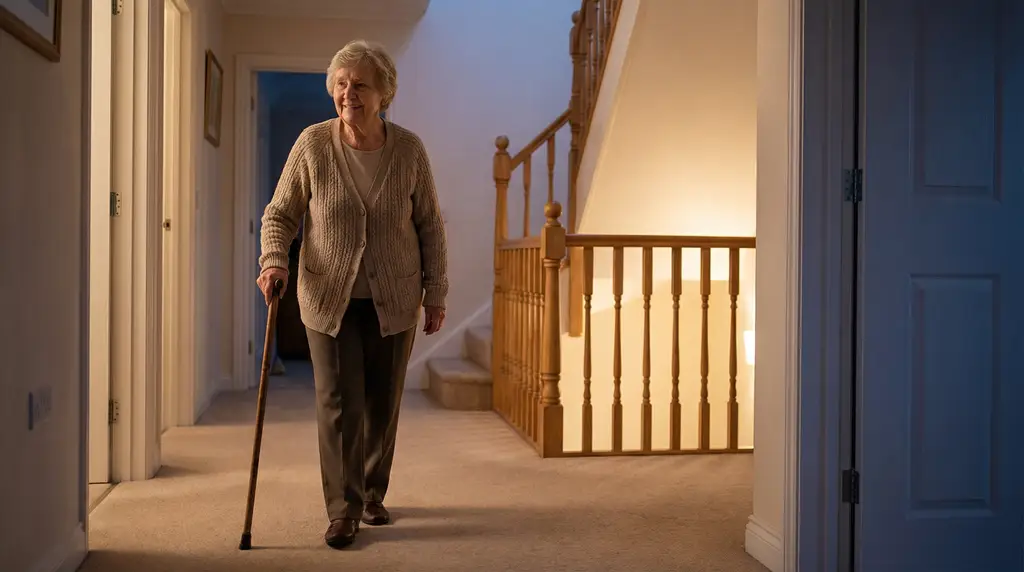
Motion-activated lighting means no fumbling for switches in the dark. Lights come on automatically when your parent gets out of bed, illuminating the path to the bathroom.
Smart plugs eliminate trailing cables from lamps. One less thing to trip over.
Activity monitoring can spot increased unsteadiness. If bathroom visits are taking longer, if there’s more time spent motionless in certain rooms, the system notices. It might mean nothing. It might mean balance is deteriorating and a physio assessment is needed.
Keeping the home safe
Older people sometimes forget things. The hob left on. The front door unlocked. The bath running.
Smart home technology provides backup:
Smart plugs can cut power to appliances after a set time. If the electric heater has been on for four hours, it switches off automatically.
Door sensors can alert you if the front door is unlocked at bedtime, or if it opens at unusual hours.
Water leak sensors detect flooding from overflowing baths or burst pipes before serious damage occurs.
Temperature sensors ensure the house stays warm enough. Hypothermia is a real risk for elderly people, especially those trying to save money on heating. The NHS recommends keeping homes at least 18°C.
Maintaining connection
Isolation shortens lives. That’s not exaggeration. Research published in Perspectives on Psychological Science found that loneliness increases the risk of early death by 26%.
Smart home technology helps maintain connection:
Video calling becomes easier with smart displays. Instead of unlocking a phone and navigating apps, your parent just says “call Sarah.” Suddenly video calls happen daily instead of weekly.
Photo frames that update remotely bring your life into their home. Photos of the grandchildren, holiday snaps, Sunday lunch. A window into your world.
Voice assistants provide a presence of sorts. Someone to ask questions, request music, or just say good morning to. Not a replacement for human contact, but something.
For more on using technology against isolation, see our guide on technology and elderly loneliness.
What technology works best for independent living
Not all smart home technology matters equally for elderly independence. Some features are useful but optional. Others matter more.
High impact
Motion sensors throughout the home. The foundation of any monitoring system. They build a picture of daily patterns and catch changes early.
Door sensors on external doors. Know when your parent leaves the house, when they return, whether they’re going out at unusual times.
Motion-activated night lights. Falls prevention at low cost. Lights in the hallway, bathroom, and bedroom that turn on automatically.
A reliable alert system. Whether alerts go to you, a monitoring centre, or both, the system needs to work every time. Reliability matters more than features.
Medium impact
Smart plugs on key appliances. Useful for monitoring kettle use (a proxy for “up and making tea”) and for auto-shutting heaters or other appliances.
Temperature monitoring. Important if your parent tends to under-heat the house. Less critical if heating is reliable and well-programmed.
Video doorbell. Lets your parent see who’s at the door without getting up. Helpful for security and for avoiding unnecessary trips to the door.
Lower impact (but still useful)
Voice assistant. Helpful for making calls and asking questions, but requires some learning. Not everyone takes to voice control.
Smart heating controls. Convenient, but many elderly people prefer a simple thermostat they understand.
GPS trackers. Only relevant for parents with dementia who might wander. Otherwise unnecessary.
When technology isn’t enough
Smart home technology extends independence. It doesn’t extend it forever.
Technology works well when your parent:
- Can manage basic daily activities (eating, washing, dressing) mostly independently
- Has occasional lapses but not constant confusion
- Accepts the technology or at least tolerates it
- Has family members or carers who can respond to alerts
Technology isn’t enough when your parent:
- Needs physical help with daily activities throughout the day
- Has advanced dementia and can’t be left alone safely
- Refuses all monitoring and removes or unplugs devices
- Has no one available to respond when alerts occur
The honest answer is that technology delays the point at which residential care becomes necessary. For some families, that delay is years. For others, it’s months. But the delay isn’t infinite.
When the time comes that technology isn’t enough, it’s not a failure. It’s simply the next stage. Technology bought time. That time was valuable.
The cost comparison
Money isn’t the only factor, but it matters.
Residential care in the UK costs £800-1,400 per week for a standard care home, more for nursing care. That’s £41,000-73,000 per year. Most people fund this themselves until their assets fall below the threshold for local authority support.
Live-in care costs £1,000-1,500 per week or more.
Smart home technology costs a fraction of this:
- Equipment: £300-1,500 depending on the system
- Monthly monitoring: £0-60 depending on whether you use professional monitoring
- Total first year: £300-2,200
- Ongoing years: £0-720
If technology extends independent living by even six months, it has paid for itself many times over. More importantly, it has bought six more months of your parent living in their own home, in familiar surroundings, with their independence intact.
Getting started
If you’re considering smart home technology to help your parent stay independent, start by understanding their specific situation.
What are the actual risks? Falls? Forgetting things? Isolation? Heating problems? Different risks call for different technology.
What would your parent accept? Some embrace technology; others resist it. Understanding their concerns helps you choose an approach they’ll tolerate.
Who will respond to alerts? You? A sibling? A professional monitoring service? The technology only works if someone can act on the information.
Our needs assessment walks through these questions systematically. Or contact us to talk through your specific situation.
Your parent wants to stay home. The right technology can help make that possible for longer.