When someone you love receives a dementia diagnosis, the future suddenly feels uncertain. How long can they stay at home? How will you keep them safe? What happens when you’re not there?
Smart home technology won’t cure dementia or stop its progression. But it can help your parent live safely at home for longer, maintain familiar routines, and give you peace of mind during the long months and years of caring.
This guide explains how technology supports people with cognitive decline, what it can and cannot do, and how to approach it sensitively.
Key Takeaways
- Smart home technology can help people with dementia stay safely at home for longer
- Passive monitoring works better than technology requiring the person to do anything
- Door sensors and night lighting address common safety concerns like wandering
- Technology supports carers too, reducing worry and helping you respond quickly
- The right approach depends on the stage of dementia and individual circumstances
Understanding dementia and technology
Dementia affects memory, thinking, and behaviour. The challenges it creates at home include:
- Forgetting daily tasks like taking medication, eating meals, or turning off appliances
- Confusion about time leading to getting up at night thinking it’s morning
- Wandering leaving the house at inappropriate times or getting lost
- Safety risks from falls, kitchen accidents, or leaving doors unlocked
- Isolation as communication and social engagement become harder
Technology can address many of these challenges. Not by asking your parent to learn anything new, but by working quietly in the background, noticing patterns and alerting you when something needs attention.
The Alzheimer’s Society provides detailed guidance on assistive technology for dementia. It’s worth reading alongside this guide.
How smart home technology helps
The best technology for dementia care is invisible. Your parent doesn’t need to interact with it, remember to use it, or understand how it works. It simply monitors and alerts.
Activity monitoring
Motion sensors throughout the home track daily patterns. Your parent gets up, moves to the kitchen, spends time in the living room, goes to bed. The system learns what’s normal.
When patterns change significantly, you receive an alert. No movement by mid-morning might mean a fall or illness. Unusual activity at 3am might indicate night-time confusion. Staying in the bathroom for an hour might suggest a problem.
For someone with dementia, this passive monitoring catches issues that would otherwise go unnoticed until the next visit. You can check in by phone: “Just wanted to say hello. Everything okay?”
Door sensors and wandering alerts
Wandering is one of the most frightening aspects of dementia care. Your parent might leave the house at night, walk down the street in their pyjamas, or set off to “go home” without knowing where that is.
Door sensors alert you whenever external doors open. You can set time-based rules: if the front door opens between 10pm and 6am, send an immediate alert. During the day, you might just want a notification rather than an alarm.
Some families add GPS trackers as well. A small device worn as a watch or in a pocket lets you locate your parent if they do leave home. This provides backup when door alerts alone aren’t enough.
The goal isn’t to trap your parent inside. It’s to know when they leave so you can check they’re safe and respond quickly if they’re not.
Automated lighting
People with dementia often experience “sundowning,” increased confusion and agitation in the late afternoon and evening. Night-time can be particularly difficult, with disorientation leading to falls or attempts to leave.
Motion-activated lighting helps in several ways:
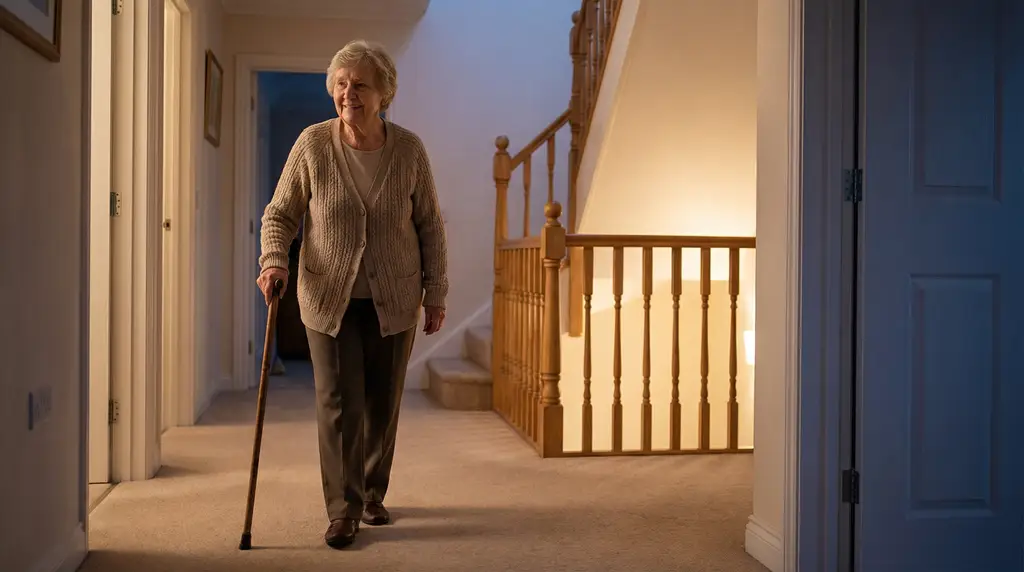
- Night-time navigation. Lights come on automatically when your parent gets up, illuminating the path to the bathroom without fumbling for switches.
- Reducing confusion. Consistent lighting cues help maintain day and night orientation.
- Fall prevention. Falls are more likely in darkness. Automatic lighting removes that risk.
Some systems adjust light temperature throughout the day, warmer in evening to encourage sleep, brighter in morning to signal daytime. This supports the body’s natural rhythms.
Reminders and routines
Voice assistants can provide gentle reminders: “Time for lunch, Margaret.” “Don’t forget your tablets.” “Your daughter is coming at three o’clock.”
For someone in early-stage dementia, these prompts can help maintain independence. They’re most effective when they support existing routines rather than introducing new ones.
Reminders work less well as dementia progresses. Your parent may become confused by voices, ignore prompts, or forget what the reminder was for before they can act on it. Technology adapts as needs change.
Appliance safety
Smart plugs can turn off appliances after a set time or if left on too long. The kettle that gets boiled and forgotten. The electric heater left running. The stove that poses fire risk.
Some families remove certain appliances entirely as risks increase. Others use smart plugs to limit risk while maintaining some normality. The right approach depends on your parent’s specific situation.
What technology cannot do
Being realistic about limits helps you make better decisions and avoid disappointment.
It cannot provide physical care
Technology monitors and alerts. It cannot help your parent get dressed, prepare meals, take medication, or get up after a fall. When these needs arise, human care is required, whether from family, visiting carers, or residential staff.
It cannot replace supervision
For someone who truly cannot be left alone, no amount of monitoring substitutes for actual presence. Alerts tell you something is wrong; they don’t prevent harm. If your parent might hurt themselves in the time it takes you to respond, technology alone isn’t sufficient.
It cannot stop dementia progression
This is hard to accept, but important. Technology helps manage the current situation. It doesn’t slow disease progression or restore lost abilities. The needs will increase over time regardless of what technology you install.
It cannot force acceptance
If your parent doesn’t want technology in their home, or becomes distressed by sensors and alerts, pushing ahead may do more harm than good. Dignity and consent matter even when capacity is diminished.
Matching technology to dementia stage
Dementia is progressive. What helps in early stages may be insufficient later, and what’s needed later may not be relevant earlier. Here’s how to think about technology across the journey:
Early stage
Your parent is still largely independent but has noticeable memory problems. They might forget appointments, lose things, or repeat questions.
Helpful technology:
- Reminder systems (medication, appointments, daily tasks)
- Smart calendar displays showing today’s date and schedule
- Simplified video calling for family contact
- Location tracking if they still go out independently
- Basic activity monitoring for peace of mind
Approach: Involve your parent in choosing and setting up technology. Their input improves acceptance and lets you tailor systems to their preferences.
Middle stage
Your parent needs help with daily activities and may have significant confusion. Supervision requirements increase.
Helpful technology:
- Comprehensive activity monitoring
- Door and window sensors with alerts
- Automated lighting throughout the home
- Appliance safety controls
- Night-time monitoring
Approach: Technology supports rather than replaces visiting care. The combination of human help and technological monitoring creates a safety net.
Later stage
Your parent needs substantial care, possibly constant supervision. Communication is limited and confusion is significant.
Helpful technology:
- Basic safety monitoring (falls, wandering)
- Environmental controls (temperature, lighting)
- Communication tools for carers
- Location tracking if still mobile
Approach: At this stage, technology serves carers as much as the person with dementia. It helps you monitor wellbeing and respond to problems, but human care is the primary support.
Supporting carers and families
Technology isn’t just about the person with dementia. It also supports the people providing care.
Reducing constant worry
Caring for someone with dementia means constant low-level anxiety. Are they okay? Did they take their medication? Have they wandered off? This background worry is exhausting.
Activity monitoring provides reassurance. You can see at a glance that your parent is up and moving normally. You don’t have to wonder; you know. This matters more than people realise until they experience it.
Enabling faster response
When something does go wrong, technology enables faster response. An alert reaches you immediately rather than hours later when you visit. Quick response often means better outcomes, whether it’s a fall, illness, or confusion episode.
Sharing the load
Multi-user access lets several family members share monitoring. Siblings can split overnight alert duty. Everyone stays informed without one person bearing all the burden.
Clear visibility also reduces family conflict. When everyone can see what’s happening, disagreements about “how bad things really are” become based on evidence rather than impressions.
Providing evidence for care decisions
Hard decisions become easier with data. If you’re considering whether residential care is needed, activity records help you assess objectively. Is your parent managing safely? Are patterns deteriorating? Facts inform better decisions than feelings alone.
Dementia UK provides guidance on technology from a carer’s perspective. Worth reading.
Working alongside professional care
Smart home technology complements rather than replaces professional support. Here’s how they work together:
Home care visits
Carers who visit daily or several times per week provide hands-on support: personal care, meals, medication, companionship. Technology fills the gaps between visits, alerting you to problems and providing continuity of monitoring.
Some families share app access with care agencies so professional carers can see activity patterns and respond to alerts. This creates a team approach to safety.
Respite care
When your parent has short stays in respite care, you can temporarily pause home monitoring. When they return, everything activates again. Technology adapts to changing circumstances.
Transition to residential care
If and when residential care becomes necessary, smart home technology has served its purpose. It helped extend the time at home, provided safer living during that period, and generated data informing the decision to move.
There’s no failure in eventually needing more care than home can provide. Dementia is progressive. The goal is giving your parent the best quality of life at each stage, whatever setting that requires.
Privacy and dignity
Monitoring someone with dementia raises ethical questions. They may not fully understand or consent to surveillance. How do you balance safety with dignity?
Involving your parent early
In early stages, discuss technology openly. Explain what it does and why you think it helps. Seek their agreement. This respects autonomy while capacity exists.
Focusing on safety, not surveillance
Frame technology as safety support, not watching. Motion sensors know someone is in the kitchen; they don’t see what they’re doing. Door sensors know when doors open; they don’t record conversations. This isn’t CCTV.
Using the minimum needed
Don’t install every possible sensor “just in case.” Start with what addresses actual concerns. Add more only if needed. Over-monitoring can feel invasive and reduce quality of life.
Maintaining private spaces
Some families choose not to monitor bedrooms or bathrooms. Others find these are the most important areas for safety. There’s no right answer, only what feels appropriate for your family.
The Information Commissioner’s Office provides guidance on privacy. While home monitoring of a family member isn’t subject to the same rules as workplace surveillance, the principles of proportionality and dignity still apply.
Frequently asked questions
Can someone with dementia use smart home technology?
The best smart home systems for dementia require no interaction at all. Sensors work passively; your parent doesn’t need to do anything. Some features like voice reminders work in early stages but become less effective as dementia progresses. The key is matching technology to current abilities rather than expecting your parent to learn new skills.
Does smart home technology prevent wandering?
It alerts you to wandering rather than physically preventing it. Door sensors notify you when external doors open at unusual times. GPS trackers help locate someone who has left. The goal is rapid response rather than prevention. Some families add additional measures like door locks or delayed-exit alarms, but these raise ethical questions about restricting freedom.
How much does dementia care technology cost?
Basic systems with door sensors, motion sensors, and a hub cost £300-800 for equipment plus £20-40 monthly for monitoring. More comprehensive systems with GPS tracking, appliance monitoring, and professional response cost £500-1,500 plus £40-60 monthly. Compare this to residential dementia care at £1,000-1,800 weekly. Technology can extend home living at a fraction of the cost.
Will my parent with dementia accept having sensors installed?
Acceptance varies enormously. Some people are reassured by technology that keeps them safe. Others find it intrusive or become anxious about devices they don’t understand. Installation during earlier stages, with explanation and involvement, improves acceptance. Discrete sensors (small, wireless, unobtrusive) cause less concern than obvious equipment.
When is technology no longer enough for dementia care?
Technology alone becomes insufficient when your parent needs physical help multiple times daily, cannot safely be alone even briefly, or has behaviours that require immediate human intervention. Frequent falls, inability to eat or drink safely, severe agitation, or attempts to leave despite alerts all suggest that more intensive support is needed. Technology extends home living; it doesn’t eliminate the eventual need for higher levels of care.
Getting started
If someone you love has dementia, smart home technology might help them stay safely at home while giving you peace of mind. The right system depends on their specific situation, the stage of their condition, and what concerns you most.
Our needs assessment helps you think through what might help. Or if you’d rather talk it through, contact us to discuss your family’s situation.
The NHS dementia guide provides comprehensive information on living with dementia. Alzheimer’s Society offers support groups, information, and practical help for families affected by dementia.
You’re not alone in this. Many families face similar challenges, and technology is one tool among many that can help.