Your dad fell last month. He’s fine now, but it shook everyone. The bruise has faded but the worry hasn’t. What if it happens again? What if next time he can’t get up? What if no one knows for hours?
Falls are the single biggest safety risk for elderly people at home. They cause injury, hospital stays, loss of confidence, and too often, the end of independent living. For families, preventing falls and ensuring rapid response when they happen are the top priorities.
Smart home technology offers practical solutions that go beyond traditional approaches. This guide explains what works, why it works, and how to implement it.
Key takeaways
- Falls affect one in three people over 65 and are the leading cause of injury death in over-75s
- Poor lighting is a major preventable cause of falls, especially at night
- Motion-activated lighting eliminates the need to fumble for switches in the dark
- Smart sensors can detect when someone hasn’t moved from a location, alerting family members
- Unlike pendant alarms, smart monitoring doesn’t require your parent to do anything
The scale of the problem
Falls in elderly people aren’t minor incidents to brush off. The statistics tell a stark story.
In the UK, around one in three people aged 65 and over experience at least one fall per year. For those over 80, it’s nearly one in two. Falls are the leading cause of injury-related death in people over 75.
The consequences extend beyond the immediate injury:
Physical harm. Hip fractures are particularly devastating. Around 30% of people who fracture a hip die within a year. Those who survive often never regain their previous mobility.
Hospital stays. Falls account for over 4 million bed days in NHS hospitals each year. Time in hospital often leads to further decline, especially for older people.
Loss of confidence. After a fall, many people become afraid of falling again. They move less, go out less, and become more isolated. This inactivity accelerates physical decline, creating a vicious cycle.
Loss of independence. A serious fall is often the event that triggers a move to residential care. What was manageable at home becomes impossible after hip surgery or a head injury.
The NHS falls prevention guidance explains why falls happen and what can reduce risk. The causes are usually addressable: poor lighting, trip hazards, medication effects, reduced balance and strength.
Why lighting matters so much
Poor lighting is one of the most common and fixable causes of falls. The problem is particularly acute at night.
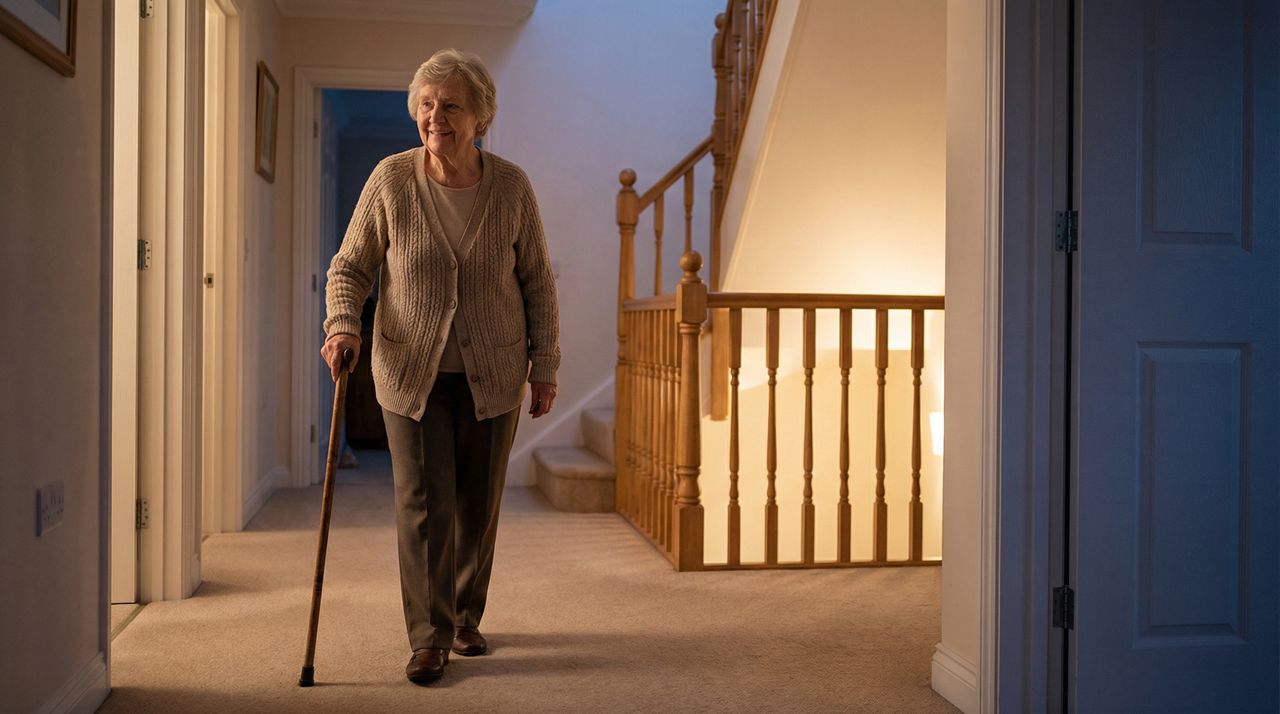
Picture your parent getting up to use the bathroom at 2am. The bedroom is dark. The hallway is darker. They’re half asleep, not fully alert. They reach for a light switch they can’t see, or don’t bother because they think they know the way.
That’s when falls happen. A rug they couldn’t see. A shoe left in the hallway. A misjudged step. In the dark, with sleep-slowed reactions, even a minor obstacle can cause a serious fall.
Traditional solutions have problems:
Night lights: Help a bit, but provide minimal illumination and don’t cover whole routes.
Leaving lights on: Wastes electricity, disturbs sleep, and doesn’t solve the problem if your parent forgets.
Touch lamps or easy switches: Still require your parent to find and operate them in the dark.
Smart lighting solves this properly.
How motion-activated lighting works
Motion-activated smart lights turn on automatically when someone enters a room or hallway. No switches to find. No fumbling in darkness. Your parent gets up, the lights come on, they can see where they’re going.
The setup typically includes:
Motion sensors placed in hallways, bedrooms, bathrooms, and stairs. These detect movement using infrared technology. They don’t see details or record video. They simply register that someone is there.
Smart bulbs or light strips that receive signals from the sensors and turn on automatically. Brightness can be set to appropriate night-time levels, bright enough to see clearly without being dazzling.
Timers that turn lights off after a period of no movement, so you’re not wasting electricity.
The result: your parent walks from bedroom to bathroom in a safely lit path, without touching a single switch.
Pathway lighting
For the highest-risk journey (bedroom to bathroom at night), consider dedicated pathway lighting:
- Low-level lights along the floor or skirting board
- Automatic activation when the bedroom sensor detects getting out of bed
- Amber-tinted light that’s easier on sleepy eyes than bright white
- Automatic shut-off once your parent returns to bed
This targeted approach addresses the specific journey where most night-time falls occur.
Stairway lighting
Stairs are particularly dangerous. Falls on stairs often cause serious injury because of the distance fallen and hard edges hit.
For stairs, smart lighting should:
- Illuminate from top and bottom
- Activate before your parent reaches the first step
- Remain on until they’ve completed the journey
- Be bright enough to clearly see each step
Some families add LED strip lights under each stair nosing for extra visibility.
Beyond lighting: sensors that spot trouble
Motion-activated lights prevent many falls. But what about when a fall happens anyway? The second challenge is ensuring help arrives quickly.
The problem with pendant alarms
Pendant alarms have been the standard solution for decades. Your parent wears a button around their neck. If they fall, they press the button, and help is summoned.
Pendant alarms save lives. But they have significant limitations:
Your parent must wear it. Many don’t. The pendant ends up in a drawer, on the bedside table, or taken off in the bathroom, exactly the place where falls most often happen.
Your parent must be able to press it. After a fall, they might be unconscious, confused, or unable to reach the button.
Your parent must be willing to press it. Many older people resist “making a fuss” or don’t want to bother anyone. They lie on the floor hoping to get up themselves, even when they can’t.
It only works after the fall. The pendant does nothing to prevent falls or detect when something has gone wrong.
Smart monitoring addresses these gaps without replacing the pendant.
How passive monitoring detects problems
Smart home systems build a picture of normal activity patterns. Motion sensors in each room know roughly where your parent is throughout the day and night. When something breaks the pattern, the system alerts you.
Scenario: bathroom fall at night
Your parent goes to the bathroom at 1am. Normal. The bathroom sensor registers their presence. After 10 minutes, they would usually be back in bed. After 20 minutes, still in the bathroom. After 30 minutes, still there. The system sends you an alert.
You call. No answer. You contact a neighbour with a spare key, or alert emergency services. Help arrives.
Without monitoring, your parent might lie there until morning when someone happens to check.
Scenario: fall in the living room
Your parent doesn’t appear in the kitchen to make their usual morning tea. The kettle sensor shows no use by 10am. Motion sensors show they’re still in the living room but haven’t moved to other rooms for hours.
The system alerts you. You call to check. Either everything’s fine (they’re just having a quiet morning) or you’ve caught a problem early.
Dedicated fall detection
For higher-risk situations, dedicated fall detection devices add another layer:
Wearable sensors: Devices worn on the wrist or body that detect sudden movements consistent with falling. They can automatically alert without requiring a button press.
Room-based fall sensors: More advanced sensors that can detect when someone falls within their range using radar or other technology. No wearable required.
These complement passive monitoring by providing immediate alerts for falls, rather than waiting for an unusual activity pattern to emerge.
Creating a safer home environment
Technology helps, but physical modifications matter too. Addressing hazards reduces fall risk regardless of what monitoring you install.
Remove trip hazards
Walk through your parent’s home looking for anything that could catch a foot:
- Loose rugs (secure with non-slip backing or remove entirely)
- Trailing cables (route along walls, use cord covers)
- Clutter on floors and stairs
- Raised thresholds between rooms
- Uneven flooring or carpet edges
Improve general lighting
Beyond motion-activated lights:
- Replace dim bulbs with brighter alternatives
- Add lamps in dark corners
- Ensure light switches are at accessible heights
- Consider touch-activated or voice-controlled lights for areas your parent uses frequently
Address bathroom risks
The bathroom is the most dangerous room. Wet floors, hard surfaces, and activities requiring balance create a perfect storm.
- Install grab rails by the toilet and bath
- Use non-slip mats inside the bath and on the bathroom floor
- Consider a walk-in shower if getting into the bath is difficult
- Ensure there’s something to hold onto when getting on and off the toilet
Make the stairs safer
- Ensure solid handrails on both sides
- Check that carpeting is secure, not loose or worn
- Apply non-slip strips to wooden steps
- Mark the edge of each step clearly if edges are hard to see
- Remove any clutter from stairways
Review furniture arrangement
- Ensure clear walking paths through rooms
- Remove low furniture that’s hard to see and easy to trip over
- Choose chairs and sofas that are easy to get up from
- Position furniture so there’s always something to steady against
Age UK’s falls prevention guide covers these modifications in detail. RoSPA’s home safety advice provides additional practical guidance.
Getting the right balance
Preventing falls matters. So does preserving your parent’s quality of life. An environment so controlled that they feel restricted or infantilised isn’t actually safer because it damages mental health and may cause them to reject support entirely.
Involve your parent in decisions
Don’t install technology without discussion. Explain what you’re proposing and why. Listen to their concerns. Involve them in choosing what works for their home and routines.
Start with the highest-impact changes
You don’t need to do everything at once. Prioritise:
- Motion-activated lighting for the bedroom-to-bathroom route
- Removal of obvious trip hazards
- Bathroom grab rails
- Basic activity monitoring
Add more over time if needed.
Respect their independence
The goal is to help your parent stay safely in their home, not to surveil them constantly. Motion sensors don’t record video. Activity data shows patterns, not detailed surveillance. Explain this clearly.
Accept that some risk remains
Falls can happen even with every precaution in place. Technology reduces risk and ensures faster response; it doesn’t eliminate the possibility entirely. A degree of risk is part of living independently at any age.
When falls indicate bigger problems
Repeated falls, even with good safety measures in place, may signal that living alone is becoming too risky.
Warning signs that more intensive support is needed:
- Multiple falls in a short period
- Falls without clear cause (not tripping on something)
- Falls related to balance problems or dizziness
- Inability to get up after a fall without help
- Falls causing serious injury
These situations call for medical assessment. The GP can check for underlying causes (medication side effects, blood pressure problems, neurological issues) and refer to falls clinics or physiotherapy.
For families dealing with dementia and falls, see our guide to smart homes and dementia care. Cognitive decline creates particular fall risks that need specific approaches.
Making the technology work
If you’re ready to implement smart fall prevention technology, here’s how to approach it:
Step 1: Assess the home
Walk through your parent’s home noting:
- Routes they regularly walk, especially at night
- Areas with poor lighting
- Trip hazards that need addressing
- Rooms where monitoring would be most valuable
Step 2: Plan the lighting
Decide where motion-activated lights would help most. Priorities are usually:
- Bedroom (to activate when getting out of bed)
- Route from bedroom to bathroom
- Bathroom
- Stairs if your parent uses them at night
Step 3: Plan the monitoring
Consider which rooms need motion sensors for activity monitoring. Typically:
- Main living areas (living room, kitchen)
- Bedroom
- Bathroom
- Hallway
Step 4: Choose your approach
Decide whether to DIY alone or use guided setup support. Guided setup ensures optimal placement and configuration without the high cost of on-site installation.
Step 5: Install and test
Get everything working and verify that:
- Lights activate reliably and brightly enough
- Sensors detect presence in all areas of each room
- Alerts reach your phone correctly
- Your parent understands what’s been installed and why
Step 6: Monitor and adjust
After a few weeks, review how it’s working. Are there dark spots the lighting misses? Areas sensors don’t cover properly? Alerts that come too often or not often enough?
Taking the next step
Falls are a serious risk, but they’re not inevitable. The right combination of smart lighting, home modifications, and activity monitoring significantly reduces the chance of a fall and ensures faster response when one happens.
Your parent can stay safer in their home. You can worry less. That’s what technology should do.
Our complete guide to keeping elderly parents safe at home covers the full range of safety considerations. For peace of mind beyond fall prevention, see our guide on how smart alerts keep families informed.
Ready to make your parent’s home safer? Our needs assessment helps you understand what would make the biggest difference. Or contact us to discuss your specific situation with our team.